

Publications
Stache Lab Publications
Research Articles
-
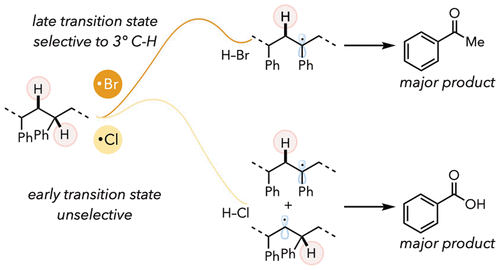
Mechanistic insights enable divergent product selectivity in catalyst-controlled photooxidative degradation of polystyrene
ACS Catal. 2023, 13, 16, 10968–10975
Research Article
Publication Abstract
Polystyrene upcycling to valuable commodity feedstocks is essential for reducing plastic waste. Photooxidative degradation has emerged as a method for converting polystyrene to oxidized aromatic compounds. Investigating the mechanism of photooxidative degradation is essential for understanding the pathways to generating different small molecules. Here, we leveraged the reactivity differences between chlorine and bromine radicals to study the degradation mechanism of polystyrene. While degradation with chlorine radical yields primarily benzoic acid (50 mol %), bromine radical shows an increased preference for acetophenone (4 mol % for both products). After conducting several mechanistic studies, we discovered that activation of 3° C–H bonds is necessary to form acetophenone. However, for acetophenone production, a second hydrogen atom transfer from H–Br enables the reformation of a methyl group on the polymer chain end. Lastly, with the mechanistic insights in hand, we added exogenous bromine sources to increase the concentration of HBr and improved the acetophenone yield, becoming the major degradation product. We envision that our insights into the polystyrene degradation mechanism will further enable divergent product selectivity.
-
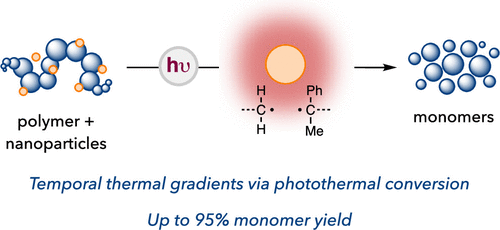
Photothermal Mediated Chemical Recycling to Monomers via Carbon Quantum Dots
J. Am. Chem. Soc. 2023, 145, 29, 16090–16097
Article
Publication Abstract
Plastic recycling strategies to combat rapidly increasing waste buildup are of utmost environmental importance. Chemical recycling to monomers has emerged as a powerful strategy that enables infinite recyclability through depolymerization. However, methods for chemical recycling to monomers typically rely on bulk heating of polymers, which leads to unselective depolymerization in complex polymer mixtures and the formation of degradation byproducts. Here, we report a selective chemical recycling strategy facilitated by photothermal carbon quantum dots under visible light irradiation. Upon photoexcitation, we found that carbon quantum dots generate thermal gradients that induce depolymerization of various polymer classes, including commodity and postconsumer waste plastics, in a solvent-free system. This method also provides selective depolymerization in a mixture of polymers, not possible by bulk heating alone, enabled by localized photothermal heat gradients and the subsequent spatial control imparted over radical generation. Photothermal conversion by metal-free nanomaterials facilitates chemical recycling to monomers, an important approach in addressing the plastic waste crisis. More broadly, photothermal catalysis enables challenging C–C bond cleavages with the generality of heating but without indiscriminate side reactions typical of bulk thermolysis processes.
-
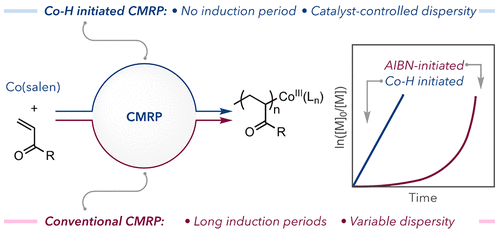
A Hydrometalation Initiation Mechanism via a Discrete Cobalt-Hydride for a Rapid and Controlled Radical Polymerization
J. Am. Chem. Soc. 2022, 144, 29, 13311–13318
Article
Publication Abstract
Cobalt-mediated radical polymerization (CMRP) is a versatile technique for controlling the polymerization of vinyl monomers via reversible termination using CoII complexes as persistent radical deactivators. Here, we report a facile approach for the in situ generation of Co–H as a discrete initiator and mediator for CMRP of acrylate and acrylamide monomers, overcoming the limitations of existing initiation strategies. In situ oxidation of a CoII complex followed by transmetalation with silane generates a Co-H species, which initiates polymerization via hydrometalation of the monomer. This method precludes an induction period with excellent control over targeted molecular weight and dispersity. Strikingly, our approach allows complete polymerization when the induction period ends for conventional CMRP. A broad scope of monomers is amenable to this protocol, including acrylates and acrylamides. Tunable catalyst electronics afford tailored dispersity while maintaining agreement in molecular weight in stark contrast to conventional methods. Elimination of this induction period imbues polymerization behavior entirely to the catalyst electronic effects on reversible deactivation/activation rates.
-
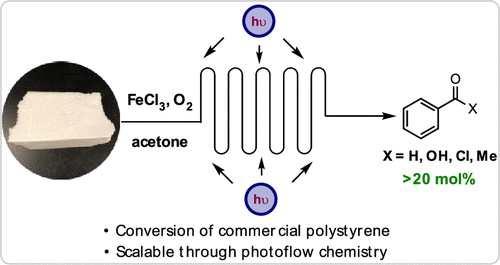
Chemical Upcycling of Commercial Polystyrene via Catalyst-Controlled Photooxidation
J. Am. Chem. Soc. 2022, 144, 13, 5745–5749
Communication
Publication Abstract
Chemical upcycling of polystyrene into targeted small molecules is desirable to reduce plastic pollution. Herein, we report the upcycling of polystyrene to benzoyl products, primarily benzoic acid, using a catalyst-controlled photooxidative degradation method. FeCl3 undergoes a homolytic cleavage upon irradiation with white light to generate a chlorine radical, abstracting an electron-rich hydrogen atom on the polymer backbone. Under the oxygen-rich environment, high MW polystyrene (>90 kg/mol) degrades down to <1 kg/mol and produces up to 23 mol % benzoyl products. A series of mechanistic studies showed that chlorine radicals promoted the degradation via hydrogen-atom abstraction. Commercial polystyrene degrades efficiently in our method, showing the compatibility of our system with polymer fillers. Finally, we demonstrated the potential of scaling up our approach in a photoflow process to convert gram quantities of PS to benzoic acid.